
KNOLLS · HISTORY
An old lake bed
crossed by history.
A vanished inland sea left the ground. Emigrants, railroad crews, highway builders, racers and bomber crews came next, and BLM wrote the rules riders follow today.
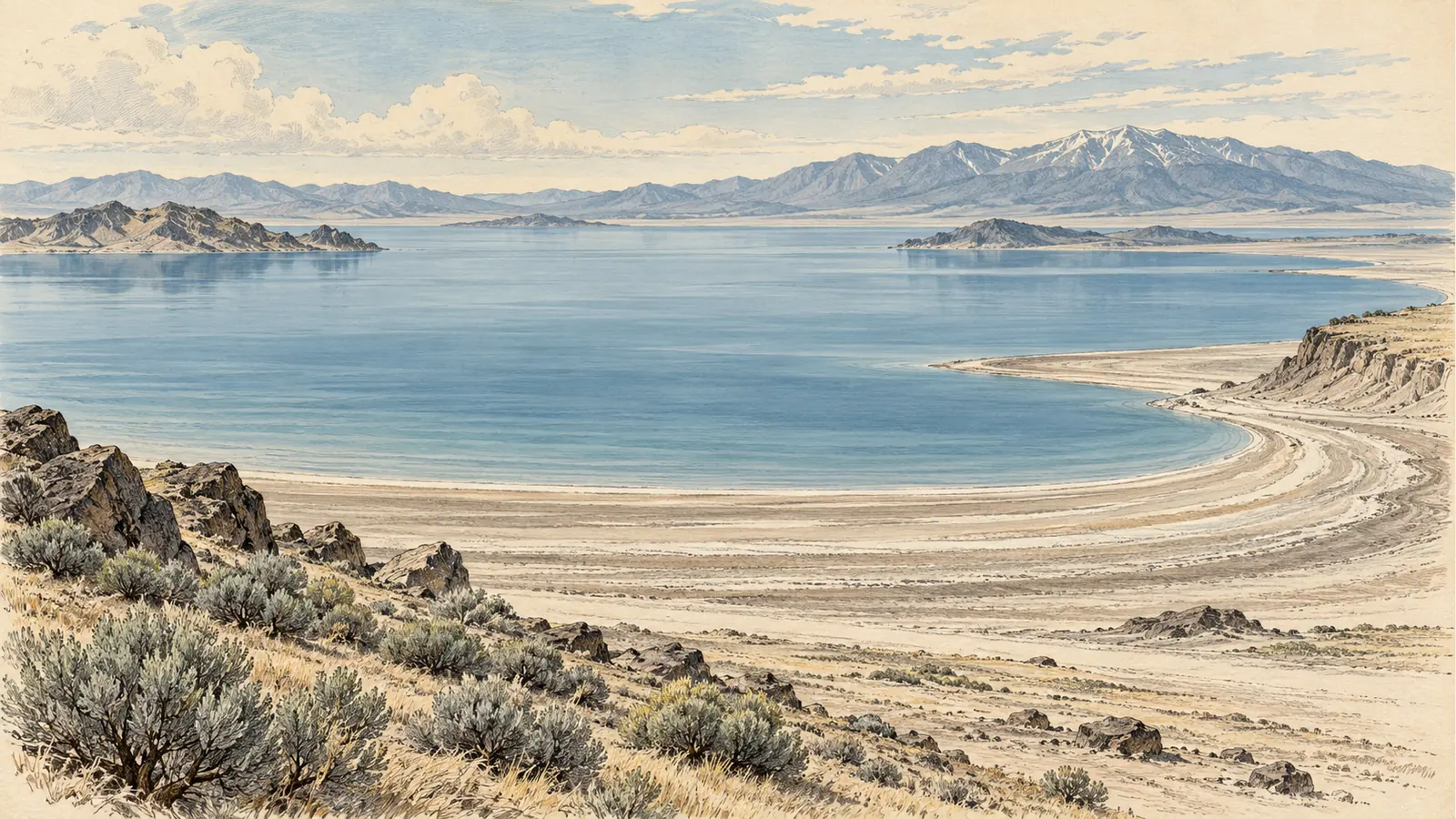
When this was a lake
The Great Salt Lake Desert sits in the basin of Lake Bonneville, an Ice Age lake that existed from about 30,000 to 13,000 years ago. The Utah Geological Survey describes it as about 325 miles long and 135 miles wide, covering some 20,000 square miles, and more than 1,000 feet deep at its peak about 18,000 years ago. From about 16,000 years ago it fell quickly, reaching roughly the level of today's Great Salt Lake within about 2,000 years.

Source: Utah Geological Survey: Great Salt Lake and Lake Bonneville questions. Checked September 10, 2026.
The Donner party's desert
In 1846 the Donner-Reed party followed the Hastings Cutoff west across Utah. The party entered the Great Salt Lake Desert on August 30, and the crossing took six days instead of the two Lansford Hastings had predicted. Four wagons and many of the animals were lost. With no time to rest their stock, they could not get over the Sierra Nevada before early snows blocked the high passes in late October.

Sources: Utah History to Go: The Donner Party, National Park Service: Hastings Cutoff. Checked September 10, 2026.
A railroad across the salt
The Western Pacific began laying track west from the Jordan River near Salt Lake City on May 18, 1906. In April 1907 the line crossed the Great Salt Lake Desert to Wendover, a stretch that included a very long straight tangent, and it reached the Nevada line on May 2, 1907.

Source: UtahRails.net: Western Pacific in Utah. Checked September 10, 2026.
Where the name comes from
OnlineUtah describes Knolls as a siding on the Western Pacific at the eastern edge of the Great Salt Lake Desert, used as a camp for railroad workers and later for Interstate 80 construction crews. The name refers to the many knolls in the area.
Source: OnlineUtah: History of Knolls. Checked September 10, 2026.
The Lincoln Highway comes through
Knolls is the eastern end of the Wendover Cut-off, a 40.3-mile road across the Bonneville Salt Flats to Wendover. Secretary of Agriculture Henry C. Wallace approved the two-lane road in 1923, and the $380,000 highway opened on June 13, 1925. On October 20, 1926, the cut-off was designated US 40, and the same day the Lincoln Highway Association gave up its southern route to Ely and approved routing the Lincoln Highway along the cut-off.

Source: Wikipedia: Wendover Cut-off. Checked September 10, 2026.
Speed on the salt
West of Knolls, the salt flats had already drawn racers. Teddy Tetzlaff went 141.73 miles per hour there in 1914, faster than the record at Daytona Beach, but automobile clubs refused to recognize it. In 1925 Ab Jenkins raced a train to the dedication of the new Lincoln Highway, and on September 3, 1935, Sir Malcolm Campbell reached 301.1202 miles per hour. Jenkins raced alone in 1940, and once the United States entered the war, no one used the salt flats for several years.

Sources: Utah History to Go: Utah's Ugly Duckling Salt Flats, BLM: Bonneville Salt Flats. Checked September 10, 2026.
Bomber crews over the desert
During World War II, several bombardment groups trained at Wendover on B-17s, B-24s and B-29s, bombing mockups of battleships and cities built in the desert. The 1,500 men of the 509th Composite Group practiced dropping dummy bombs on Utah's desert until they were ready, and on August 6, 1945, the Enola Gay flew over Hiroshima. When the Wendover property was later split up, the test range land was kept, and in 1979 it became the Utah Test and Training Range. Interstate 80 passes through a wide gap between its two sections.

Sources: Utah Division of State History: 1945 Atomic Bombs on Japan, Wikipedia: Utah Test and Training Range. Checked September 10, 2026.
A managed riding area
In 2005 the BLM Salt Lake Field Office published supplementary rules for the Knolls Special Recreation Management Area, covering fees, camping near water, glass, stunts, shooting and quiet hours. In 2018 the Deseret News reported visitation up 42 percent in five years alongside a proposed fee increase, and BLM has since moved pass sales online.
Sources: Federal Register: Knolls SRMA supplementary rules, 2005, Deseret News, April 13, 2018, BLM: Knolls pass purchases move online. Checked September 10, 2026.
This is an independent planning guide. Fees, hours, closures, fire orders and riding boundaries change. Confirm the current details with the BLM Salt Lake Field Office.