CORAL PINK SAND DUNES · HISTORY
Sand from stone,
shaped by a gap.
The pink comes from sandstone, the dunes come from the wind, and the footprints nearby are older than both.
Stone into sand
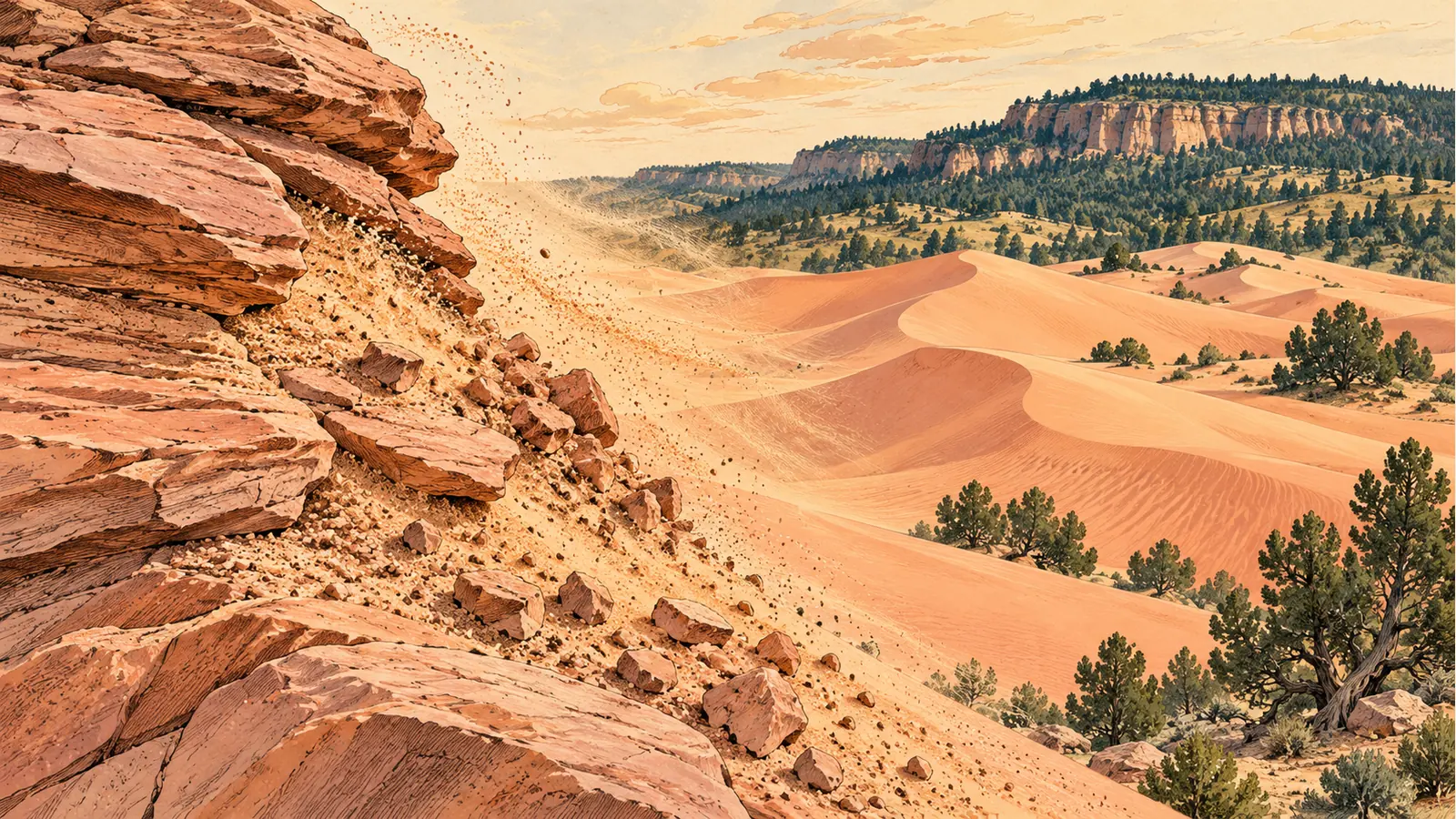
The dunes are built from pink Navajo Sandstone eroding in the country around the park. Wind funnels through the notch between the Moquith and Moccasin mountains, speeds up and picks up loose grains. Once it spills into the open valley it slows, and the sand drops. That is the Venturi effect, and it is still at work every windy afternoon.

Sources: Utah State Parks: Discover Coral Pink, Wikipedia: Coral Pink Sand Dunes State Park, citing Utah State Parks. Checked September 10, 2026.
Young dunes, ancient rock
Utah State Parks estimates the dunes at 10,000 to 15,000 years old. The stone they come from is vastly older. At the BLM's Moccasin Mountain Dinosaur Tracksite nearby, hundreds of fossilized dinosaur and other animal footprints sit in the same Navajo Sandstone, dating to about 180 million years ago in the early Jurassic.
Sources: Utah State Parks: Discover Coral Pink, BLM: Moccasin Mountain Dinosaur Tracksite. Checked September 10, 2026.
Hollywood on the sand
Kanab, 22 miles east, became known as Little Hollywood for the westerns filmed around it, and the dunes had screen time of their own. James V. D'Arc's history of moviemaking in Utah, When Hollywood Came to Town, as cited on Wikipedia, places parts of Arabian Nights (1942) and One Little Indian (1973) at Coral Pink Sand Dunes.

Sources: Wikipedia: Arabian Nights (1942 film), citing James V. D'Arc, Wikipedia: One Little Indian, citing James V. D'Arc, Utah Business: Kanab and Kane County, August 7, 2026. Checked September 10, 2026.
A state park since 1963
Coral Pink Sand Dunes became a Utah state park in 1963. Today the dune field is co-managed by Utah State Parks and the BLM Kanab Field Office, with the open sand continuing onto the north end of the Moquith Mountain Wilderness Study Area.

Sources: Wikipedia: Coral Pink Sand Dunes State Park, citing Utah State Parks, BLM: Coral Pink Sand Dunes. Checked September 10, 2026.
The beetle that shaped the rules
The Coral Pink Sand Dunes tiger beetle lives here and nowhere else. The federal government proposed listing it as threatened in 2013 and withdrew the proposal later that year. Protection now rests on a conservation agreement between Utah and the BLM that keeps off-road vehicles out of about 265 acres where the beetles concentrate, while about 90 percent of the dune field stays open to riding.

Source: KUER, June 30, 2026. Checked September 10, 2026.
Visiting the tracks
From the park, BLM directs visitors west on County Road 1000 for 6.89 miles, then onto BLM Road 30 to the parking area. The last stretch has deep sand, so BLM recommends high-clearance four-wheel drive. There is no fee.

- Do not walk directly on the tracks
- Do not remove material or deface the surface
- Do not make molds or casts
Source: BLM: Moccasin Mountain Dinosaur Tracksite. Checked September 10, 2026.
This is an independent planning guide. Fees, hours, closures, fire orders and riding boundaries change. Confirm the current details with Utah State Parks and the BLM Kanab Field Office.