
CORAL PINK SAND DUNES · RIDING
Know the sand
you can ride.
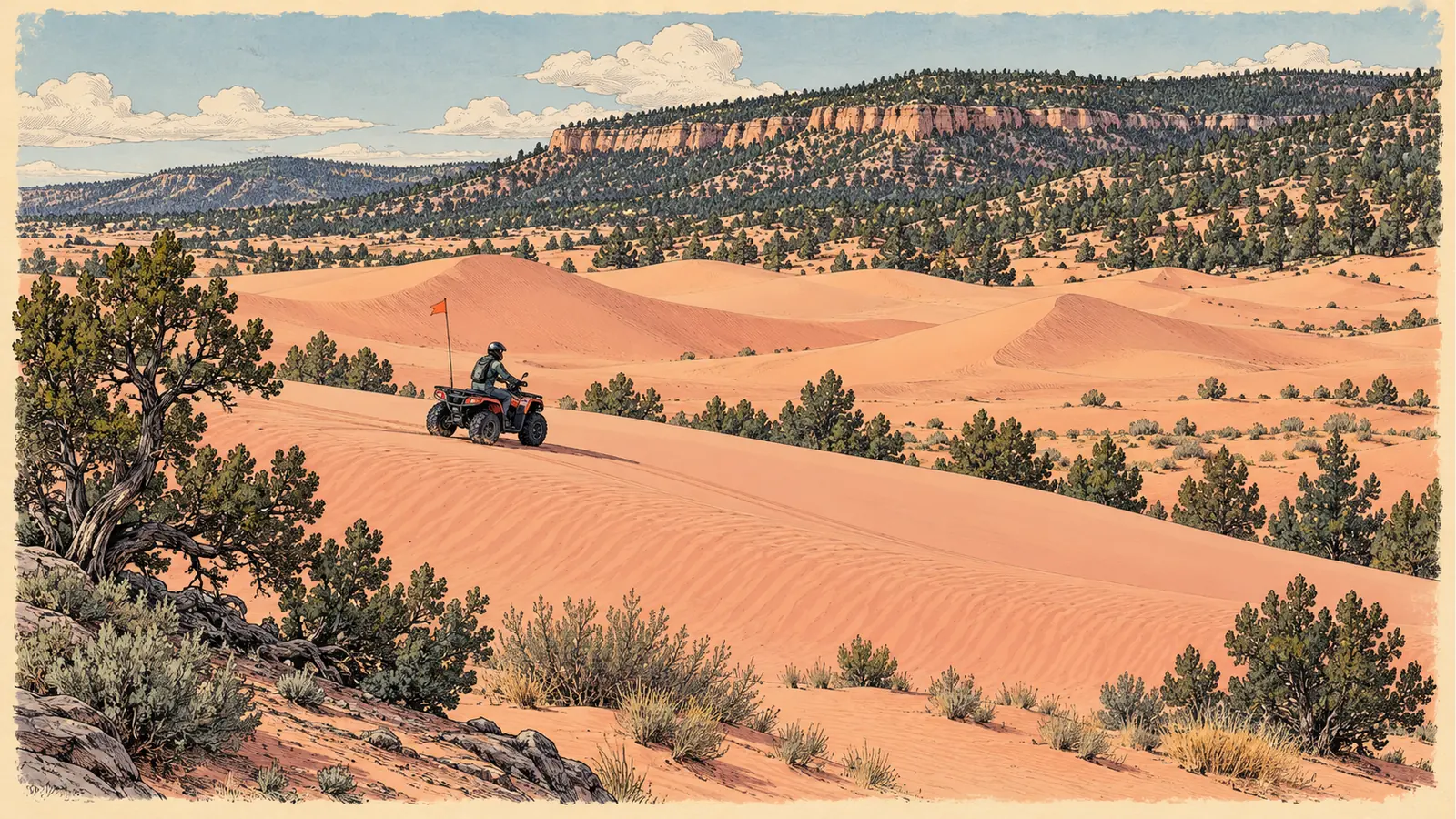
Most of this dune field is open to machines. The parts that are not are signed on the ground, and the sand does its best to bury the signs.
Where you can ride
Utah State Parks says about 90 percent of the dunes are open for riding, and that every dune, including the closed ones, is open to hiking and playing in the sand.
BLM counts roughly 1,500 acres of open sand dunes spanning the park and the north end of its Moquith Mountain Wilderness Study Area. Inside that WSA, OHVs may use designated roads and the open dunes only.
Where the sand gives way to brush on the BLM side, you are leaving the open dunes. Turn back onto sand or a designated road rather than cutting across.
Sources: Utah State Parks: Discover Coral Pink, BLM: Coral Pink Sand Dunes, BLM: Moquith Mountain. Checked September 10, 2026.
The tiger beetle area is closed to vehicles
The Coral Pink Sand Dunes tiger beetle lives here and nowhere else. The park's rule is simple: vehicles are not allowed in the beetles' home range, and the area is marked with signs.
KUER reported in June 2026 that a conservation agreement between Utah and the BLM keeps OHVs out of about 265 acres where the beetles are most concentrated, while roughly 90 percent of the dune field stays open to riding. The same report notes that shifting sand swallows the fence posts that mark the area, which makes the signs easy to miss.

A buried post is still a boundary. One set of tracks through the closure is enough to damage habitat the beetle cannot replace.
Sources: Utah State Parks: Coral Pink current conditions, KUER, June 30, 2026. Checked September 10, 2026.
Riding hours
The park lists its hours, and its OHV operating hours, as daylight hours seven days a week. Plan the ride so everyone is back off the sand before dark rather than counting on lights.
Sources: Utah State Parks: Coral Pink OHV safety tips, Utah State Parks: Coral Pink Sand Dunes. Checked September 10, 2026.
Reading the dunes
These are wind-built dunes, and their shapes change. Treat every crest as unknown until you have seen what is behind it.
- Approach crests at an angle and slow enough to stop
- Keep the whip flag up where riders coming the other way can see it
- Ride with a partner and agree on a regroup point before splitting up
- Save the steepest faces for machines with the power to finish the climb
Sand without an engine
The park rents sandboards and sleds at the visitor center for $25 each, first come, first served. Rentals stop an hour before closing and are due back 30 minutes before it.
Source: Utah State Parks: Coral Pink current conditions. Checked September 10, 2026.
Common questions
Are all the dunes at Coral Pink open to OHVs?
No. About 90 percent are open. The tiger beetle conservation area is closed to vehicles and is marked with signs, and on BLM land OHVs must stay on designated roads or the open dunes.
Can you ride at night at Coral Pink Sand Dunes?
The park lists OHV operating hours as daylight hours, seven days a week.
This is an independent planning guide. Fees, hours, closures, fire orders and riding boundaries change. Confirm the current details with Utah State Parks and the BLM Kanab Field Office.